
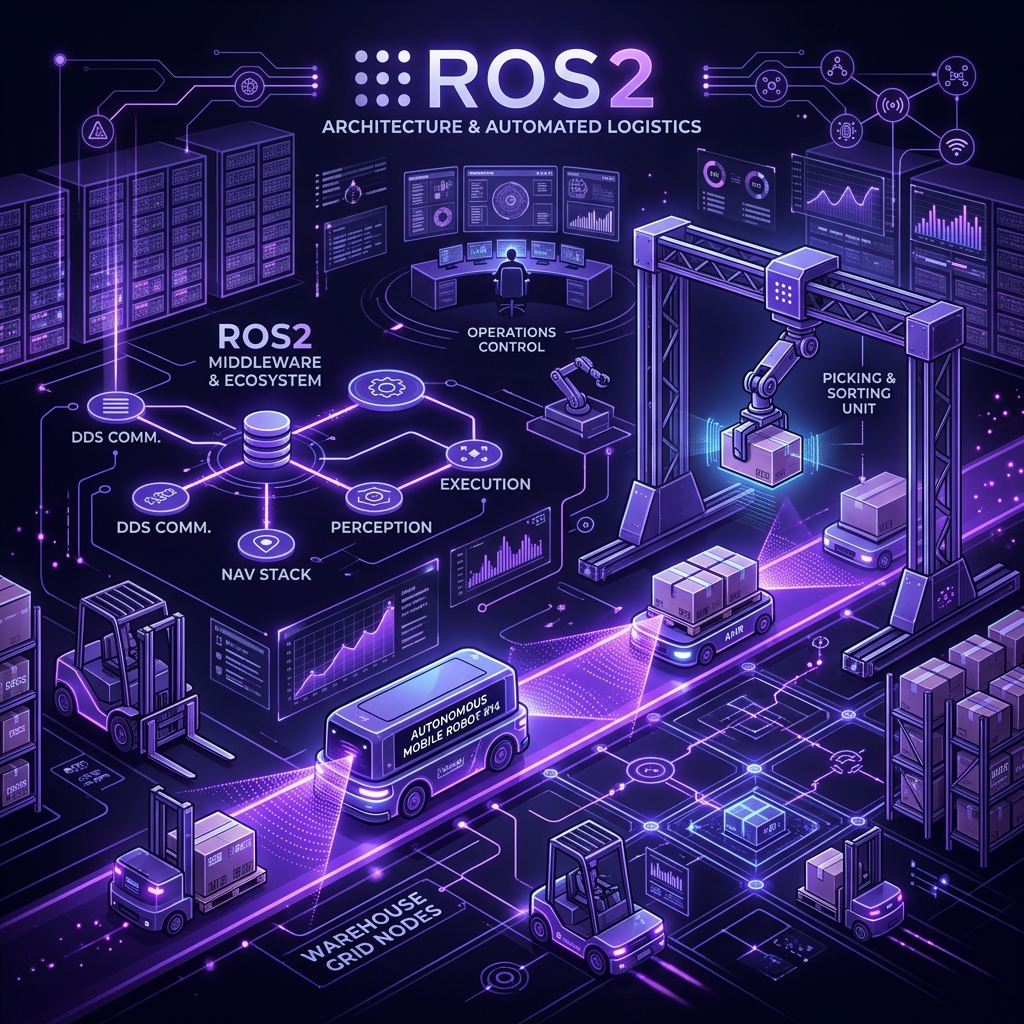
In the field of industrial automation, Robot Operating System 2 (ROS2) has emerged as the standard middleware framework. From autonomous mobile robots (AMRs) in warehouses to robotic sorting arms, ROS2 provides the communication architecture that makes modern logistics possible.
The Evolution from ROS to ROS2
While the original ROS revolutionized robotic research, it lacked the real-time execution guarantees, security, and multi-robot orchestration features needed for industrial deployment. ROS2 addresses these limitations by utilizing Data Distribution Service (DDS) for its communications layer. This ensures reliable, secure, and low-latency message routing between robotic components, even across wireless networks.
"ROS2 has shifted robotics from an academic science to an enterprise engineering standard. Its publisher-subscriber nodes are now driving global supply chain automation."
Key Pillars of ROS2 Logistics
Modern automated warehouses rely on ROS2 to maintain efficiency and safety:
- Distributed Node Communication: ROS2 nodes represent separate tasks (e.g. lidar scanning, path planning, motor control) that communicate asynchronously.
- Nav2 Navigation Stack: An advanced navigation package that handles collision avoidance, dynamic mapping, and path planning for mobile warehouse bots.
- Lifecycle Node Controls: Managing state changes (configuration, activation, deactivation) ensures clean startup sequences and dynamic error recovery.
Robotics Education at Nova Haven
Nova Haven's Robotics & Automation curriculum, designed in partnership with QuantumMind Academy, is built around ROS2. Students configure workspace packages, write custom C++ and Python publisher nodes, and simulate fleet operations in Gazebo. This industry-aligned training prepares them to step directly into roles as robotics technicians and deployment engineers.