
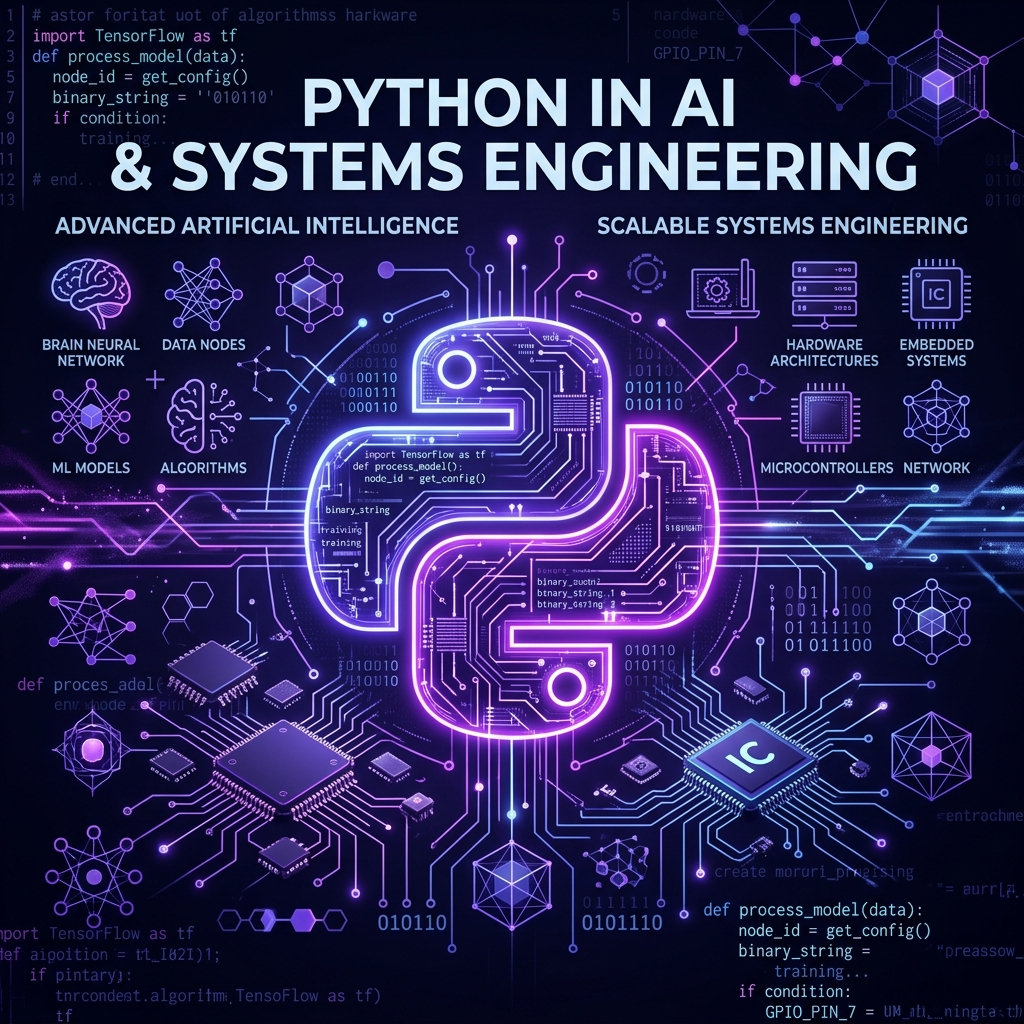
From deep learning models to low-level hardware controllers, Python remains the backbone of the technical world. Its expressiveness, rich library ecosystem, and adaptability make it the undisputed language of systems engineering.
The Dual Nature of Python
Traditionally, programming languages were split between high-level web languages and low-level hardware languages like C/C++. Python has bridged this gap. In 2026, engineers write high-level data models in PyTorch or TensorFlow, and deploy them on microcontrollers using MicroPython. This unified approach eliminates compile bottlenecks and facilitates rapid prototyping.
"Python's strength is not just its syntax, but its ecosystem. It is the language that connects mathematical models directly to electrical actuators."
Why Python Dominates in 2026
Python remains dominant due to key structural and historical advantages:
- Robust AI Frameworks: Almost all state-of-the-art neural network research, LLM runtimes, and vector search libraries are native to Python.
- MicroPython and CircuitPython: Microcontrollers like the ESP32 and Raspberry Pi Pico run Python natively, allowing simple motor control and sensor reading.
- Unparalleled Developer Community: An expansive repository of packages ensures that whatever system you are integrating, there is already a library for it.
Syllabus Integration at Nova Haven
Our students at Nova Haven begin with fundamental Python scripts and quickly scale to microcontrollers and machine learning models. By building end-to-end telemetry systems and neural classifiers, our graduates acquire the cross-disciplinary coding experience that recruiters value most.