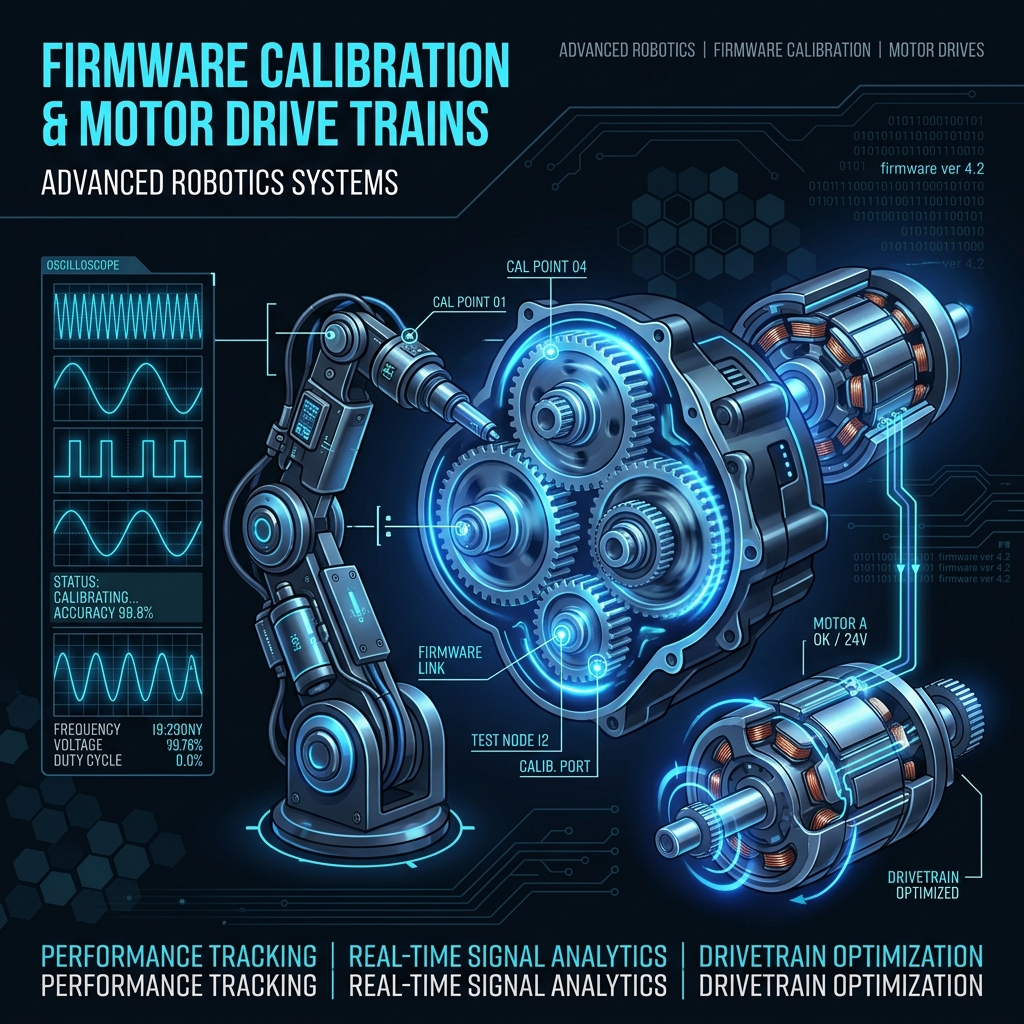
Precision movement is the foundational requirement of any functional robot. Achieving smooth, micro-millimeter precision requires a delicate synergy between physical motor gearboxes and the low-level firmware algorithms that control them.
The Challenge of Drive Train Calibration
In theory, sending a command to move a motor 90 degrees is straightforward. In practice, mechanical backlash, friction variations, thermal expansion, and payload weights introduce physical errors. Firmware engineers must implement closed-loop control systems—most commonly PID (Proportional-Integral-Derivative) loops—to monitor motor encoders in real-time and dynamically adjust electrical currents.
"Motors and gears are only as smart as the control loops executing in firmware. Microsecond latency loops are the difference between a jerky movement and a fluid, precise gesture."
Keys to Successful Motion Calibration
Calibrating mechanical drive trains involves several core engineering steps:
- High-Resolution Encoders: Utilizing magnetic or optical encoders to measure rotational angles at thousands of steps per revolution.
- PID Tuning: Carefully setting proportional, integral, and derivative gains to eliminate overshoot and oscillation under shifting loads.
- Backlash Compensation: Writing software offsets into the firmware to account for microscopic gaps between interlocking gears.
Hands-on Labs at Nova Haven
Nova Haven's Robotics lab challenges students to assemble, wire, and calibrate multi-axis arm segments. Working with osciloscopes and custom control panels, they write hardware-level C code to configure PWM signals and debug encoder telemetry. This rigorous hardware exposure prepares them to design, build, and test mechanical structures in modern manufacturing plants.